

“AI will replace customer service.”
“AI will eliminate developers.”
“AI will automate analysts.”
“AI will run entire businesses.”
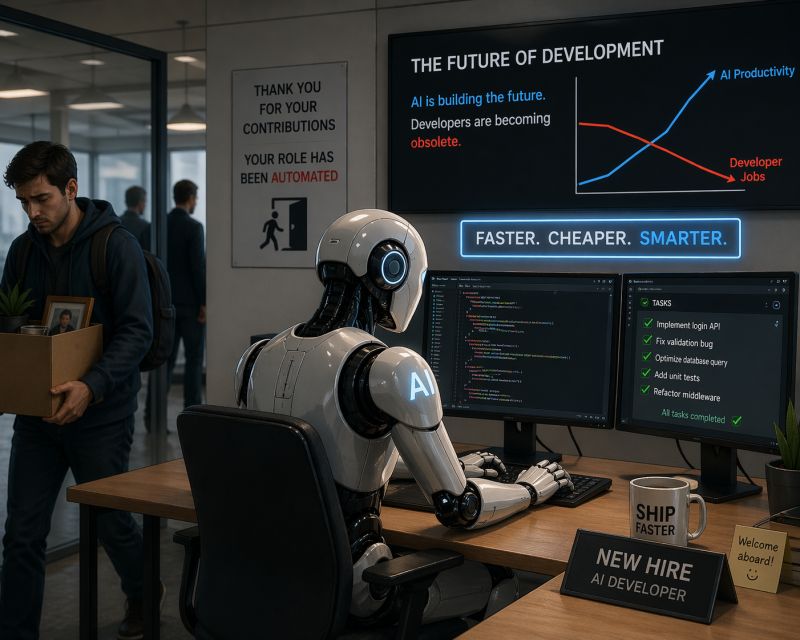
For the past two years, the narrative has been relentless: AI is coming for the creatives, the coders, and the communicators. We’ve seen headlines of mass layoffs and “AI-first” restructurings that made it seem like human expertise was becoming a legacy cost. But as we move into mid-2026, a surprising new trend is emerging, the “Layoff Boomerang.”
From fintech giants to academic researchers, the world is waking up to a stark reality: replacing humans with algorithms is often more expensive, less effective, and strategically dangerous. If you are a young person wondering if you should still pick up a digital pen, a paintbrush, or a keyboard, the answer is a resounding yes. Here is why the “AI takeover” is hitting a human wall.
The Great Quality Reversal
Perhaps no company leaned into AI more aggressively than Klarna. Just a year ago, the fintech giant claimed its AI assistant was doing the work of 700 agents. However, in a major strategic pivot, Klarna has recently resumed hiring human customer support staff. CEO Sebastian Siemiatkowski admitted that a singular focus on cost-cutting led to a measurable drop in service quality.
“Really investing in the quality of the human support is the way of the future for us,” Siemiatkowski noted, acknowledging that while AI handles volume, it lacks the empathy and nuance required for complex human problems.
- Klarna Reverses Course on AI Customer Support, Resumes Human Hiring
- As Klarna flips from AI-first to hiring people again, a new landmark survey reveals most AI projects fail to deliver
The Economic Illusion: AI is Not Cheaper
The boardroom promise was simple: AI is cheaper than a salary. That promise is breaking. Executives from NVIDIA and Uber recently revealed that the “compute cost” of running advanced AI agents often exceeds the cost of the employees they were meant to replace.
Bryan Catanzaro, Vice-President of Applied Deep Learning at NVIDIA, stated clearly: “For my team, the cost of compute is far beyond the costs of the employees.” Meanwhile, Uber’s CTO Praveen Naga admitted their AI budget was “blown away” as the true price of token usage and infrastructure became clear.
The “Augmentation Trap” and Skill Erosion
While the financial costs are rising, the hidden “cognitive costs” are even more concerning. A recent academic paper from MIT Sloan, titled The Augmentation Trap, warns that over-reliance on AI can lead to “intuition rust.” When we offload our thinking to a machine, we stop building the very expertise that made the AI useful in the first place.
For young professionals, this is the most important lesson: if you use AI to replace your learning, you “deskill to zero.” But if you use it to augment your work while maintaining your craft, you become part of the elite tier of “expert supervisors” that companies are now desperate to rehire.
The Rehiring Wave
The data is backing up this sentiment. Workforce analytics firm Visier recently found that 2025-2026 saw the highest rate of employee rehires since 2018. Companies that rushed into AI-driven layoffs are now “boomeranging” their talent back. Gartner projects that 50% of companies that cut headcount for AI will be rehiring for those same functions by 2027.
- Why Today’s AI-Driven Layoffs Are Becoming Tomorrow’s Rehiring Crisis
- Businesses rush to rehire staff after regretted AI-driven cuts
- Gartner Predicts Half of Companies That Cut Customer Service Staff Due to AI Will Rehire by 2027
A Call to the Next Generation
To the young writers, designers, and programmers: do not let the hype cycle discourage you. The world doesn’t need more “AI-generated” noise; it needs human-led signal.
Companies are learning the hard way that a brand without a human heartbeat is just a series of tokens. They need your taste, your ethics, and your ability to solve the problems an LLM hasn’t seen in its training data yet.
AI will not take your job—unless you willingly give up the “cognitive muscle” that makes you an expert. Stay curious, stay rigorous, and keep building. The “human-centric” era isn’t over; it’s just getting started.
Final Founder Thoughts
For software founders, there is an important lesson emerging from this entire cycle: AI is not a substitute for great teams, it is a force multiplier for them.
The companies struggling right now are often the ones that treated AI as a shortcut to remove expertise rather than a tool to amplify it. They optimized for immediate payroll reduction while underestimating the long-term value of institutional knowledge, customer trust, creativity, and human judgment. In many cases, they discovered that replacing experienced people with AI created hidden costs that were far greater than the salaries they eliminated.
As founders, we should pay close attention to that mistake.
The future advantage in software will likely not belong to companies with the fewest employees. It will belong to the companies that build environments where talented people can leverage AI to operate at extraordinary scale and speed without losing the human insight that customers actually value.
That means investing in teams that know how to think critically, validate outputs, challenge assumptions, and maintain accountability. It means designing AI systems that support human workflows instead of blindly replacing them. And it means recognizing that trust, empathy, creativity, and contextual decision-making are still incredibly difficult to automate.
There is also a deeper strategic risk here. Companies that over-automate too early may unintentionally hollow out the very expertise they need to remain competitive. If your organization stops developing thinkers, builders, investigators, and problem-solvers because AI appears “good enough,” you eventually lose the ability to innovate beyond the model itself.
The strongest companies in the next decade will not be “AI companies” or “human companies.” They will be organizations that understand how to combine both effectively.
As founders, our responsibility is not simply to chase efficiency. It is to build resilient businesses that can adapt, learn, and create lasting value. AI absolutely changes how software companies operate, but the emerging evidence suggests something many people overlooked in the rush toward automation:
The human layer is not disappearing.
It is becoming more important than ever.
AdmiralBridge Software delivers simplified retail loss prevention case management and investigation solutions that help retailers streamline operations, reduce loss, and uncover actionable insights.