
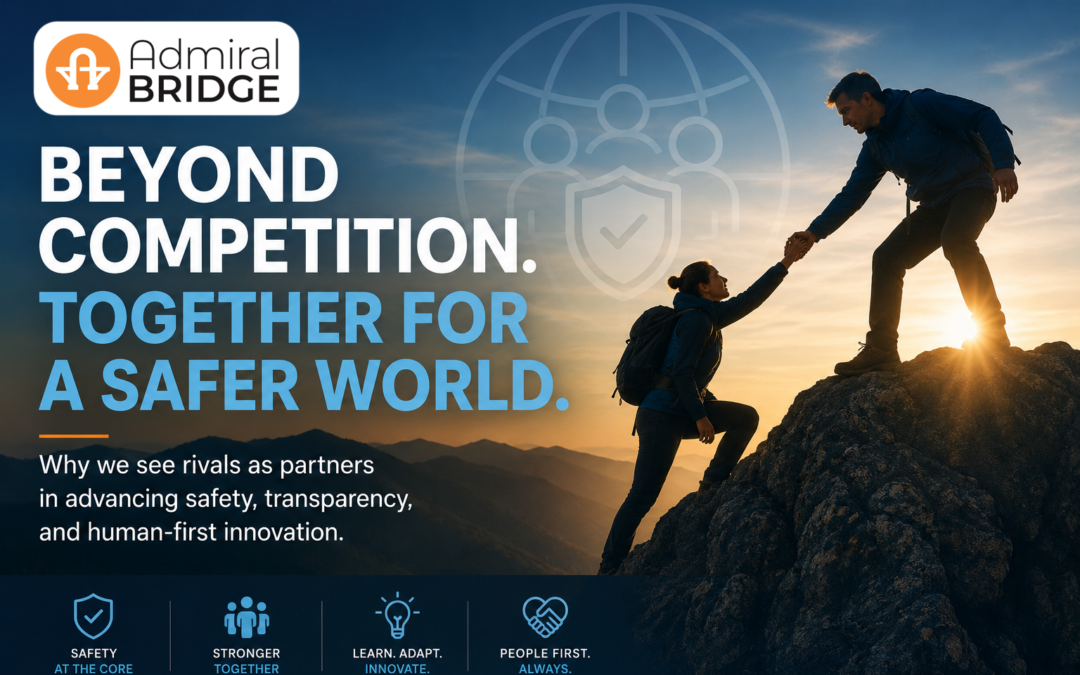
In the traditional business landscape, the word “competitor” often triggers an immediate physiological response: a tightening of the jaw, a defensive posture, and a binary view of the world defined by winners and losers. We have been conditioned to talk about market share as “territory,” positioning as “maneuvering,” and success as “beating the other guy.” For many, strategy is less about creation and more about protecting turf and eliminating threats.
But at AdmiralBridge Software, we believe there is a fundamental difference between a competitor and a rival.
We operate in the loss prevention and safety reporting space which is an industry where the stakes are far higher than quarterly dividends. In our world, incidents impact employees, customers, and entire organizations. In some cases, the effectiveness of a reporting system can be the difference between a near-miss and a tragedy. Because the human cost is so high, we have learned to think differently about the organizations surrounding us. We have realized that while we may compete for contracts, we are often collaborating on a much larger mission.
The Infinite Mindset: Shifting from Competitors to Rivals
This shift in perspective is rooted in what Simon Sinek calls The Infinite Game. In business, there are no fixed rules, no agreed-upon finish line, and no way to “win” a field like safety. Sinek argues that “in the Infinite Game, the true value of an organization is measured by the desire others have to contribute to that organization’s ability to keep succeeding.”
When we view other companies through a finite lens, we see them as enemies to be defeated. However, when we adopt an infinite mindset, we recognize what Sinek calls “Worthy Rivals.” A Worthy Rival is another player in the game worthy of comparison, whose strengths reveal our own weaknesses. As Sinek writes, “We don’t need to admire everything about them, but we must acknowledge that they have strengths from which we can learn.”
At AdmiralBridge, the only competitors we recognize in a negative sense are those motivated solely by profit, especially when that profit comes at the expense of transparency or human safety. Organizations that use sales tactics instead of product features to make sales are the competitors that we want to beat in a finite mindset. Organizations trying to solve the same problems we are? Those pushing safety culture forward? Those using technology responsibly to benefit the lives of front line employees? They are not enemies. They are the benchmark that forces us to be better.
Rethinking as a Competitive Advantage
Adam Grant, an organizational psychologist and author of Think Again, suggests that the mark of a truly successful organization is “intellectual humility”, this is the ability to recognize that the way we’ve always done things might not be the best way to do them anymore. In a rapidly evolving industry like loss prevention, ego is a liability.
Grant notes, “If knowledge is power, knowing what we don’t know is wisdom.” When a rival company introduces a more intuitive workflow or a smarter reporting process, a “competitor” reacts with dismissal or imitation. A “rival,” however, uses that moment as a catalyst for rethinking. At AdmiralBridge, we view the innovation of others not as a threat to our identity, but as a prompt for our curiosity.
If our mission is truly to reduce harm and improve safety culture, we must care more about getting it right than being right. If another team discovers a better way to empower and support front line loss prevention professionals, we don’t just acknowledge it, we study it. Their progress challenges our stagnation and ensures that the entire industry moves toward a safer future.
The Courage to Lead Without Armor
The transition from a defensive posture to a mission-driven one requires a trait often undervalued in the boardroom: vulnerability. Brené Brown, in her research on “Daring Leadership,” explains that many organizations operate out of “armored leadership”, which is a style defined by perfectionism, the need to be right, and the urge to hide gaps in knowledge.
In business, we often feel the pressure to project absolute certainty. We fear that admitting someone else does something well will be perceived as weakness. But as Brown writes, “Vulnerability is not winning or losing; it’s having the courage to show up and be seen when we have no control over the outcome.”
It takes immense confidence to recognize excellence outside your own walls. It takes maturity to admit that AdmiralBridge doesn’t have every single answer to the world’s safety and loss prevention challenges. By putting down the “armor” of corporate ego, we are able to build more authentic relationships with our customers. We aren’t just selling a tool; we are joining them in a partnership where honest conversation about where their risks lie and how we can collectively mitigate them is a natural business conversation.
Profit as Fuel, Not the Destination
To be clear, profit is essential. A business that does not generate revenue cannot sustain innovation or provide jobs. However, a problem arises when profit becomes the mission instead of the fuel. When an organization prioritizes quarterly numbers above the people they serve, trust erodes and safety is compromised.
In the safety industry, this mindset is dangerous. Technology should exist to help people; reporting should create accountability; systems should support culture, not just compliance. If another company shares these core values, we see them as part of a broader movement.
As Simon Sinek often says, “Money is like gasoline. You need it to go on the journey, but the point of the journey isn’t to buy more gas.” At AdmiralBridge, our journey is the advancement of workplace safety, empowering employees, and using technology to solve real problems. If our rivals are helping the world reach that destination faster, the “game” stays alive, and everyone, especially the employees on the front lines, wins.
Conclusion: Why We Welcome the Challenge
Business is not a finite game with a final scoreboard. There is no moment where a company “wins” safety or crosses a finish line for protecting corporate assets. The organizations that endure are those willing to stay curious, stay humble, and stay connected to a purpose larger than their own balance sheet.
At AdmiralBridge, we are committed to building technology that helps organizations respond better, report better, and learn better. We hold ourselves to a high standard, but we are grateful for the worthy rivals who hold us to an even higher one.
In the end, we aren’t just trying to build a better company. We are trying to build a safer world. And that is a mission too big to tackle alone.